Many families stop claiming Attendance Allowance the moment a parent moves into a care home, and lose thousands of pounds a year without realising. Here’s who keeps it, who doesn’t, and how to claim in England in 2026/27.
When Mum or Dad moves into a care home, there’s a mountain of paperwork, and benefits are easy to overlook. A common assumption is that Attendance Allowance stops as soon as someone moves in. For many families that simply isn’t true, and getting Attendance Allowance in a care home can be worth up to £114.60 a week.
Whether you keep it depends mainly on one thing: who is paying the care home fees. Below we explain how the rules work in England for 2026/27, what changes if the council starts paying, and how to make a claim if your loved one has never applied.
The short answer: yes, you can get Attendance Allowance in a care home if you pay all of the care home fees yourself, at either £76.70 or £114.60 a week in 2026/27. If the council or the NHS pays for the placement, Attendance Allowance usually stops after the first 28 days.
What Is Attendance Allowance?
Attendance Allowance is a benefit from the Department for Work and Pensions (DWP) for people over State Pension age who need help with personal care or supervision because of a physical or mental health condition or disability. It isn’t means-tested, so savings, pensions and the value of a house make no difference to whether you get it.
There are two weekly rates for 2026/27:
Lower rate, £76.70 a week: for people who need frequent help or constant supervision during the day, or supervision at night.
Higher rate, £114.60 a week: for people who need help or supervision both day and night, or who are nearing the end of life.
It’s based on the help a person needs, not the help they actually get. Someone living in a care home will almost always meet the care test, because needing that level of support is usually why they moved in. You can read the full Attendance Allowance eligibility rules on GOV.UK.
Attendance Allowance in a Care Home: Who Keeps It?
If you pay all of your care home fees yourself, you can keep Attendance Allowance.
If the local council pays towards your care home fees, Attendance Allowance usually stops after 28 days.
If the NHS pays for your care home place, for example through NHS Continuing Healthcare, it also usually stops after 28 days.
If you were in hospital shortly before moving in, the two stays can be linked, so payments may stop sooner.
Self-funders are the group most likely to miss out. Families sometimes assume the benefit is “for people at home” and stop claiming, or never apply in the first place. In fact, a self-funder in a care home is exactly the kind of person who can keep receiving it.
Why Attendance Allowance in a Care Home Matters for Self-Funders
Care home fees are high, and every pound helps. Over a year, Attendance Allowance is worth around £3,988 at the lower rate and around £5,959 at the higher rate. For a self-funder, that money can go straight towards the fees and help savings last longer before they fall to the council threshold.
Getting Attendance Allowance can also unlock extra help elsewhere. GOV.UK confirms that people who receive it may get more Pension Credit, and self-funders in a care home can keep the extra amount for severe disability that is paid with Pension Credit. If your loved one is on a modest pension, it’s worth checking.
In England, someone with more than £23,250 in capital usually pays the full cost of their care. Once their capital falls towards that level, the council can step in and start contributing. At that point, the person is no longer paying all of their own fees, so Attendance Allowance in a care home will usually stop 28 days after the council starts paying.
It’s important to tell the DWP when this happens. GOV.UK warns that failing to report a change can lead to overpayments that have to be paid back, and in some cases a penalty.
There are some special situations where the rules work differently, for example if the council is funding the placement temporarily while your loved one’s home is being sold, or during the 12-week property disregard. These cases can be complicated, so ask the Attendance Allowance helpline or an independent adviser such as Age UK before assuming payments must stop. Our guide on whether you have to sell your house to pay for care explains the property rules in more detail.
How to Claim Attendance Allowance in a Care Home
If your loved one has never claimed, it’s not too late. To qualify, they must usually have needed help for at least six months, unless they are nearing the end of life.
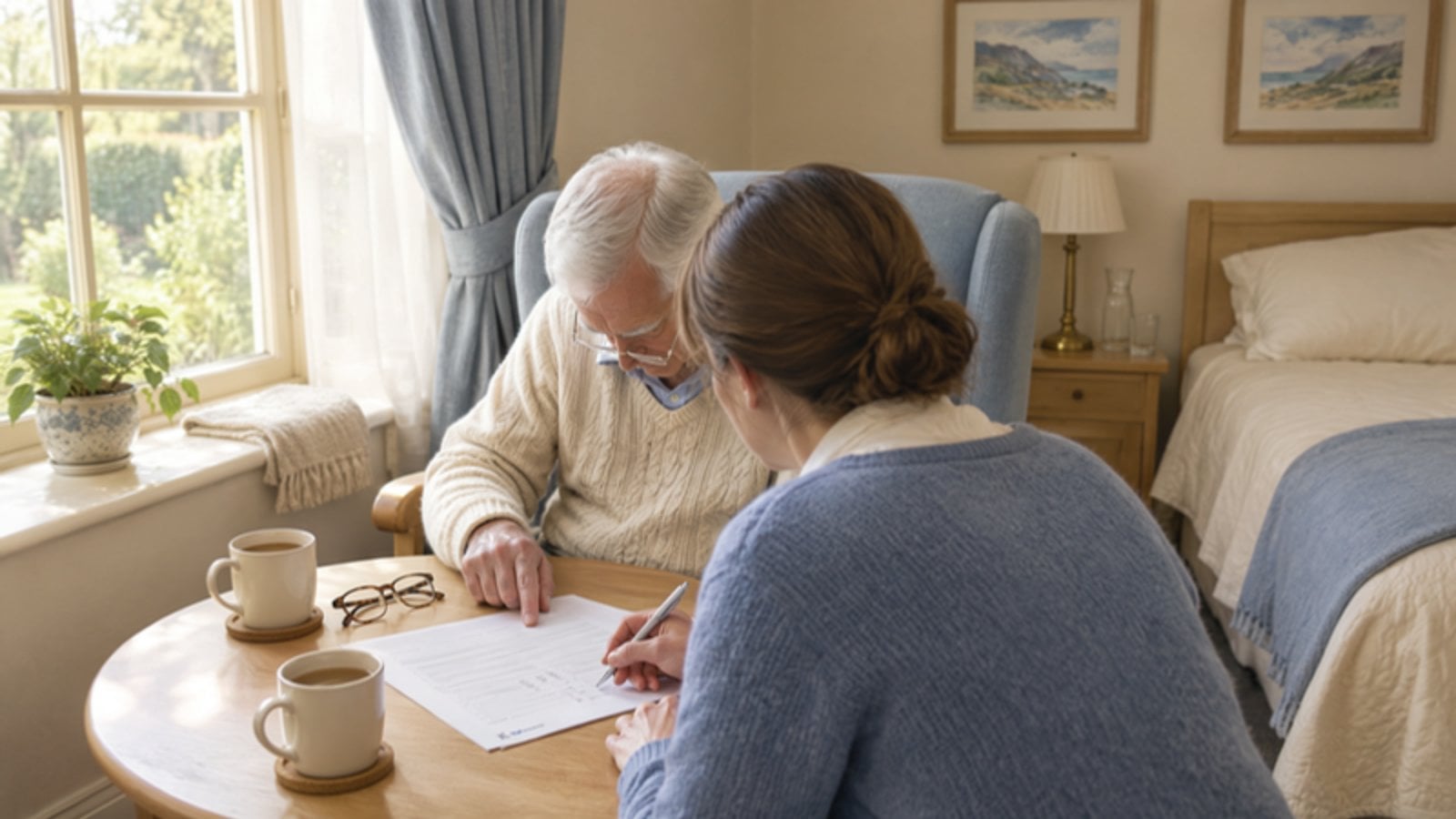
You claim using form AA1. You can download it from GOV.UK, but it’s usually better to phone the Attendance Allowance helpline and ask for a form to be posted. If you return a form sent by the helpline within six weeks, the claim can be paid from the date of the call. Attendance Allowance can’t be backdated, so every week of delay is money lost.
When filling in the form, focus on the help needed, not just what goes well. Useful details include:
help with washing, dressing, eating and using the toilet
help taking medication
how often they need someone with them to stay safe, day and night
falls, confusion or wandering, including at night
anything the care home staff do that your loved one couldn’t manage alone
Care home staff often keep detailed care records, and these can be a helpful source of examples. If your loved one can’t manage their own affairs, someone with Lasting Power of Attorney can make the claim for them.
Nearing the end of life? If a doctor or nurse believes someone may have 12 months or less to live, special rules apply. The six-month waiting period doesn’t apply, the higher rate is paid automatically, and claims are fast-tracked. Ask the doctor for an SR1 medical report to send with the form.
Respite Stays and Attendance Allowance in a Care Home
A short stay in a care home doesn’t automatically mean losing Attendance Allowance. Payments usually only stop after 28 days in a care home funded by the council or the NHS, and if you’re paying for the respite stay yourself, payments carry on as normal. Regular planned respite can often be arranged so that payments aren’t affected, but you should still report each stay to the DWP.
FAQs
Can you get Attendance Allowance in a care home if you pay for it yourself? Yes. If you pay all of your care home fees yourself, you can keep receiving Attendance Allowance at your usual rate.
Does Attendance Allowance stop when the council pays for a care home? Usually, yes. If the council pays towards the care home fees, payments normally stop after 28 days. You must tell the DWP when the funding changes.
How much is Attendance Allowance in 2026/27? The lower rate is £76.70 a week and the higher rate is £114.60 a week. Which rate you get depends on whether you need help during the day, at night, or both.
Does Attendance Allowance depend on savings? No. It isn’t means-tested, so savings, income and property don’t affect whether you qualify. What matters is the level of care and supervision you need.
Is Attendance Allowance the same across the UK? Not quite. In England and Wales you claim Attendance Allowance. In Scotland, new claims are for Pension Age Disability Payment, and Northern Ireland has its own system. This guide covers England.
Legal disclaimer: This article is for general guidance only and does not constitute financial or legal advice. Benefit rates and rules can change, and individual circumstances vary. Always check current guidance with the DWP or your local authority, and speak to an independent adviser before making decisions about benefits or care funding.
As the Company Director at Wiserr, I lead an innovative and impactful platform that provides information and advice on care and health services in local areas. We empower informed decisions and enhance the quality of life for thousands of users, and we are featured in over 3000 GP practices across the UK.
If a loved one is moving into a nursing home, you may see NHS-funded nursing care on the fee breakdown. Here’s what it is, what it’s worth in 2026/27, who qualifies and what to check on the contract.
It’s the question almost every family asks first. The honest answer is: sometimes, but rarely straight away, and in some cases never. Here’s how the rules on your home actually work in England in 2026, and the options that give you time.
Not every care home stay has to be self-funded. NHS Continuing Healthcare pays the full cost of care for people with significant ongoing health needs — but most families have never heard of it. Here’s who qualifies, how the assessment works, and what to do if you’re turned down.
Power of Attorney only works if it’s set up before capacity is lost — leave it too late and families face a slower, costlier court process just to make care decisions. This guide covers which type of Power of Attorney you actually need for care home decisions, what it costs in 2026, and what happens if you don’t have one in place.